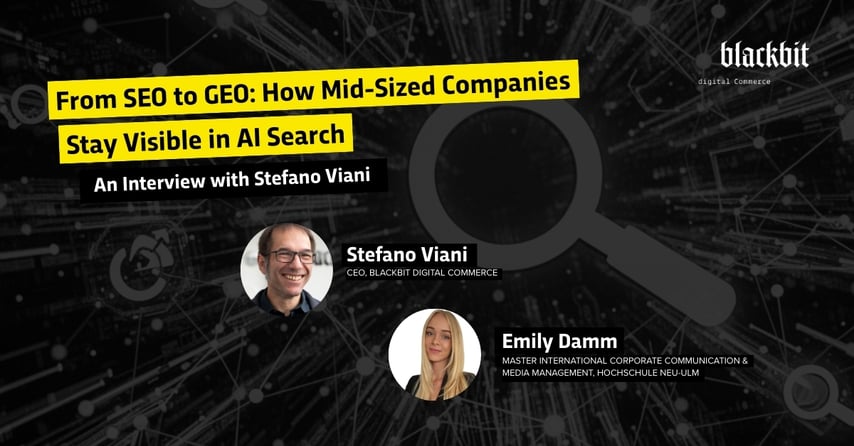
Emily Damm is researching digital visibility at Neu-Ulm University of Applied Sciences. In her master's thesis, she is investigating how classic Search Engine Optimization (SEO), i.e. search engine optimization to improve the findability of websites in search engines such as Google, is developing into Generative Engine Optimization (GEO) and what this means for brands. In an interview with Stefano Viani, Managing Director of Blackbit, she talks about changing search behavior, content strategies and the question of whether small companies can still remain visible online in the age of ChatGPT & Co.
Artificial Intelligence Is Changing the Way We Search
Artificial intelligence is increasingly finding its way into everyday life - including when searching for information. In addition to traditional search engines such as Google, more and more people are turning to AI-based systems such as ChatGPT. The impact this has on search behavior is becoming increasingly apparent in practice.
"I use Large Language Models (LLM) myself as a supplement to Google," says Viani. "Not exclusively, but as a supplement. And I see this with my children - they are ChatGPT fans and naturally do their research via chatbots."
What is also becoming apparent: In the web analytics of many Blackbit customers, the number of website visitors is declining. Emily Damm also confirms this trend in her research. She has analyzed how traffic figures have developed before and after the introduction of Google's AI Overviews: "It's already a sharp drop for all customers." This has a direct impact on how users interact with other content on the internet and which content they prefer to view.
Content Is King - But Which One?
But how can websites remain visible online despite AI? Viani's answer after 35 years in the industry: "Content is king. That's always been the case." But: me-too content - simply copying content - has never been the savior. It has to be authentic, original content: Websites need to stand out from the crowd with their content in order to be used or cited as a source by LLMs.
The Large Language Models evaluate quality in a similar way to traditional search engines, but differ in that social signals are weighted more heavily. "A visible social media presence is rated even more important as a point of trust."
Ultimately, it's about understanding user intent. What does the user want to know? What questions are they interested in? Blackbit works with tools like Conductor that identify thematic gaps on websites - where are there topics that match user interest but are not covered? In addition, these tools help to identify the visibility of your own content and also support content creation and optimization.
At the same time, Viani urges caution: "The tool landscape is not yet fully developed. Everyone wants to do AI now, everyone is coming onto the market with some nonsensical product. It reminds me of the internet euphoria of 2000/2001."
Quoted, Not Just Mentioned
Emily Damm distinguishes between two GEO goals: to appear by name in AI responses or to be quoted. "A citation is more valuable because it shows expertise," says Viani. Just being mentioned is nice - but you can't make a living from it. In the end, it's transactions, leads and checkouts that count.
Which sources do Large Language Models prefer to use? Viani estimates: "Sources with authenticity are given more weight. So where users actually write - something like Reddit." Unlike marketing content, this is real information, not prepared messages.
Brand Image: What You Didn’t Do Right Before Won’t Get Any Better Now
Generative AI can portray brands in a distorted way if the corporate language is not clear - for example, product features, functions or application options are misrepresented because the AI does not understand exactly what the company is offering But: "The risk does not arise in the AI search environment," Viani clarifies. "That's the end of the chain. That's where you see the result of what I did before." Many companies provide too vague or contradictory information about who a product is intended for and what it is intended for - and it is precisely these ambiguities that lead to distorted representations in AI results.
The question is: how many companies even have a corporate language manual? Sentence structure, sentence length, word choice, gendering - that's what characterizes corporate language. "If I haven't defined this and different employees generate content, then it's a wild growth. Then I don't have consistent brand management."
His thesis: "What I didn't do right before won't get any better now."
This also applies to user-generated content. If false information ends up in the AI, that is a risk - but nothing more than community management. "I have to exert influence. At the source, where the information comes from that later appears in the search environment."
B2B vs. B2C: Different Rules of the Game
In future, the user will spend a large part of the customer journey in the AI chatbot and will only come into contact with the company website very late or perhaps not at all. ChatGPT works with Shopify and other store providers to display products directly in the chat. "I could imagine that the checkout would then be directly in ChatGPT," believes Viani. The user no longer even enters the provider's website.
It is more difficult in the B2B sector: complicated products, configurations, maintenance contracts and individualized orders - these are not so easy to bring into the chatbot. "People are more likely to jump to the company website." But that doesn't mean the all-clear for B2B companies. Their business customers have to research much more thoroughly during the purchasing process and often only become aware of the providers in the process. Until now, customers have visited numerous websites to gather information and offers. This part of the customer journey is completely shifted to the AI chatbot. There is a good chance that providers will remain invisible because the AI only quotes a few top dogs in the industry.
Small Companies Have a Chance
What happens to small and medium-sized companies that don't adapt? Will they disappear from the market?
"It's not like that," says Viani. "Large companies need large volumes - that leaves gaps in the market." Small companies can occupy special offers and address small target groups individually. Innovation doesn't always have to come from the big players. "Sometimes all you need is innovative communication - and to be distinctive for the user."
One-word search queries are decreasing, while more complex questions are increasing. Users are speaking whole sentences instead of typing, especially on cell phones: "Users speak, they no longer write. If I can speak, I speak a whole sentence." Generative AI and voice search are already present and are becoming increasingly important for interacting with content.
The consequence: "I have to think better. But I had to before. The companies that take care of their users and marketing will come out on top."
Visibility Follows Substance
Emily Damm's research and practical experience show the same thing: In the AI-supported information space, visibility is not bought, but built. Through consistent content, clear positioning and a focus on users' actual questions.
SMEs have a structural advantage: specialization beats volume. Authenticity beats reach.
Companies that think through their content, brand management and communication structurally today are not just building visibility in AI systems. They are creating a foundation that is sustainable - regardless of which technology dominates tomorrow.

About Emily Damm:
Emily Damm is a Master's student in the International Corporate Communication and Media Management program at Neu-Ulm University of Applied Sciences. In her master's thesis, she is investigating how the digital visibility of SMEs is changing as a result of generative AI - in particular the transition from classic SEO to GEO (Generative Engine Optimization) and the effects on brand-compliant communication. Alongside her studies, she works as a working student at a digital agency.

Leave us feedback