
The German e-commerce market is on the move - and this movement is directly affecting SMEs. Many companies are currently faced with the question of whether their existing commerce platform can still support future growth or is already becoming a strategic bottleneck. Current market analyses by iBusiness and the EHI Retail Institute show a clear shift in the system landscape: platforms are noticeably gaining and losing relevance, classic enterprise systems are coming under pressure, and this is increasingly resulting in fundamental strategic decisions for SMEs.
This article summarizes the most important findings - and shows what they mean in concrete terms for medium-sized B2B companies.
Winners and Losers in the Platform Market
The market analyses by iBusiness and EHI paint a clear picture: the platform market is consolidating - not in favor of fewer systems, however, but in favor of clearer roles.
Shopware Remains Market Leader - But With a Dwindling Lead
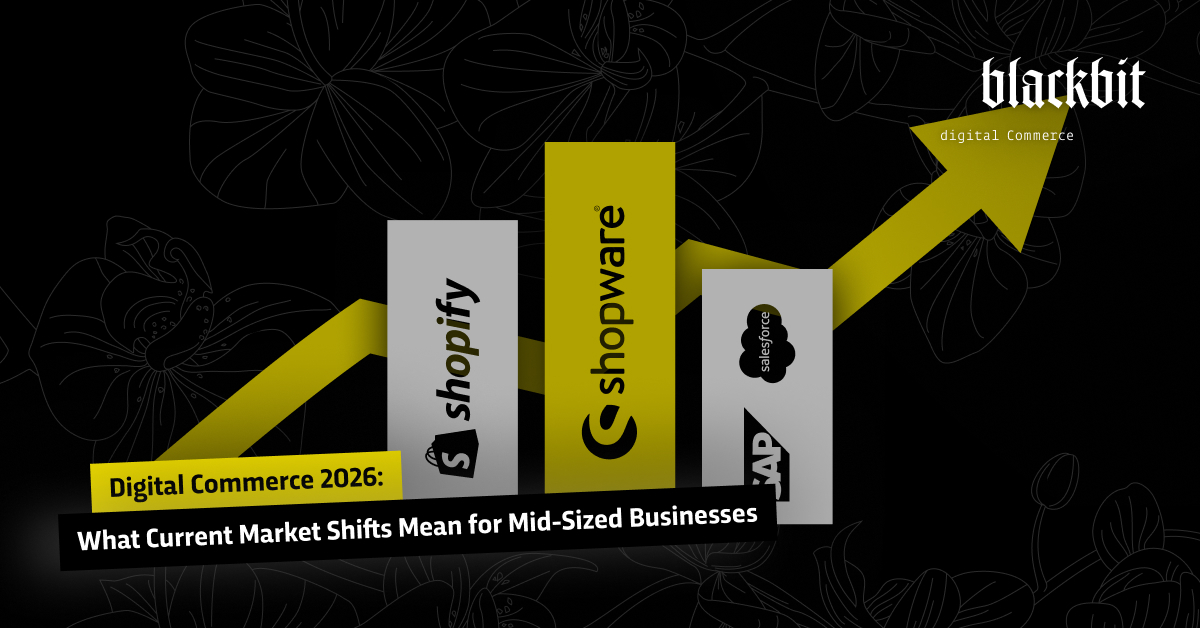
Shopware is still the most widely used store platform in German-speaking countries. However, its market share is only growing moderately. The gap between Shopware and its rivals is narrowing, particularly due to dynamic competitors with SaaS and API-focused approaches.
Shopify Is the Big Winner
Shopify is recording the strongest growth. The platform is also increasingly being used by more complex organizations. The reasons for this are the speed of implementation, the app ecosystem and scalability. For many SMEs, Shopify is therefore a realistic option beyond traditional enterprise systems for the first time.
Salesforce and Sap Are Stagnating or Losing Share
Enterprise suites are losing their appeal, particularly among SMEs. High licensing costs, long implementation times and limited adaptability are seen as the main reasons for the decline in use among SMEs.
Oxid and Older Enterprise Systems Are Losing Ground Significantly
Legacy platforms are coming under massive pressure. Maintenance costs are increasing, while the speed of innovation and integration capability are decreasing. Many retailers are currently actively preparing replacement or replatforming projects.
Increasingly Individual System Landscapes
Instead of "one-size-fits-all" platforms, more and more companies are relying on highly individualized architectures.
Trend in the SME Sector: Away From Monolithic Systems - Towards Composables
Transferring these market movements to current projects in the SME sector reveals the following development: SMEs are increasingly moving away from rigid complete solutions and developing modular, API-based system landscapes.
Typical features of this development:
- Headless commerce architectures
- Decoupling of frontend and backend
- Integration of specialized systems for
- PIM
- DAM
- CMS
- search
- Marketing Automation
The aim is no longer "one software for everything", but rather a flexible architecture that enables companies to react more quickly to market requirements and develop systems in a targeted manner without having to replace the entire platform.
What Do These Changes Mean for Medium-Sized B2B Companies?
There are clear areas of action for B2B manufacturers and technical wholesalers:
1. System decisions are becoming more strategic
The choice of commerce platform is no longer purely an IT issue, but a long-term decision for internationalization, process automation and sales efficiency.
2. Replatforming is becoming the norm
Many companies are no longer modernizing their landscape as an option, but out of technical necessity. Standstill is increasingly becoming a risk.
3. Complex requirements need modular answers
B2B-specific requirements - e.g. customer-specific prices, role and rights structures, approval processes - can be mapped much more flexibly and sustainably in modular architectures than in monolithic systems.
4. Speed becomes a competitive factor
Companies that can implement new functions or processes more quickly and open up new markets faster secure measurable competitive advantages.
Blackbit as a Technology Partner for SMEs
Blackbit supports medium-sized companies in developing a future-proof digital commerce architecture from a variety of systems.
The approach: No tool infatuation - but architectural thinking.
In concrete terms, this means
- Objective evaluation of existing system landscapes
- technology-open system selection
- Development of modular target architectures
- Realistic roadmaps for migration and modernization
The Digital Commerce Performance Roadmap (DCPR)
With the Digital Commerce Performance Roadmap (DCPR), Blackbit offers companies a structured orientation model to make technology decisions plannable, prioritized and measurable.
The DCPR helps to
- assess the maturity level of the current system landscape
- prioritize bottlenecks
- Structure bottlenecks and risks in replatforming projects
- Strategically manage investments
Conclusion
Based on current market analyses, however, the market is not consolidating in the sense of becoming less complex.
On the contrary: system landscapes are becoming more modular, more specialized and more strategic.
For SMEs, This Means
Not every trend platform is automatically the right choice. The decisive factor is an architecture that fits the business model, processes and growth targets.
Structured planning today avoids costly mistakes tomorrow.
Are you facing a platform decision? Let us evaluate your options together.

Leave us feedback