The world of online search is changing rapidly. Traditional SEO strategies are becoming less and less sufficient - especially because AI-supported tools, social search and new search engines are changing the way users find information. Medium-sized companies are facing the challenge of securing their visibility in this new landscape.
1. Search Behavior Is Changing Fundamentally
- Users are searching differently: social media is increasingly being used as the primary search engine.
- AI apps such as ChatGPT are changing the customer journey: answers are displayed directly in AI tools and clicks on websites are decreasing.
- Long-tail queries and complex search queries are becoming more important.
Facts at a glance:
- 45% of Gen Z use social media as their primary search engine
- 10% of users already search via LLMs (Large Language Models)
- Google's market share fell below 90% in 2024
- 50% of all Google searches do not result in a click
"Those who only rely on traditional SEO today are already overlooking half of the customer journey," says Philipp Zettler, SEO expert at Blackbit.
2. Classic SEO Is Losing Its Impact
Search engines like Google remain important, but:
- Organic traffic is declining: Many users no longer interact directly with websites at all.
- Brand campaigns are losing impact as AI responses and social search dominate initial contact.
- Customer data is becoming scarcer as users spend less time on websites.
Consequences for companies:
- Higher SEA costs
- Less control over brand perception
- Shift of the customer journey to new platforms
3. SEO 2.0: Search Everywhere Optimization
To remain visible in the AI and GEO era, companies need to think beyond traditional SEO:
GEO - Generative Engine Optimization
- Goal: Prepare content and brands in such a way that LLMs prefer to recognize, cite or directly integrate them.
- Measures:
- Clearly structured content
- Unambiguous, citable content
- Technical structure: Schema markup, meta data, optimized data feeds
Social Search Optimization (SSO)
- Ensure presence on social media, platforms and partner websites
- Actively manage brand perception
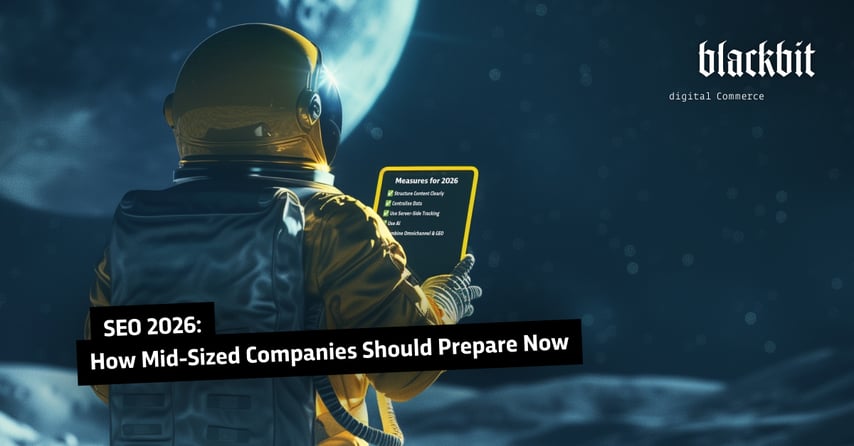
4. Measures Until 2026
1. Technical SEO & data structure
- Optimize indexing
- Pay attention to core web vitals
- Maintain structured data (schema)
- Entity optimization for brands and products
2. Adapt content strategy
- Structure content briefly, concisely and comprehensibly
- Use W-questions, key takeaways, enumerations
- Ensure originality and topicality
3. Data-driven SEO work
- Implement server-side tracking
- Analyze performance and user journey
- Continuously adapt and update content
4. Use omnichannel & GEO
- AI-compatible data feeds and metadata for LLMs
- Ensure presence on social media and partner platforms
- Consistent brand messages across all touchpoints
5. Practical tip for medium-sized companies
- Prioritize the most important channels: Where does your company generate the most traffic?
- Centralize data: Unified customer, product and content data makes automation and GEO easier.
- Use AI for insights, not just for content: analyses, forecasts and optimizations based on clean data increase efficiency.
Conclusion
SEO 2026 is no longer just a technical topic, but a strategic business tool. Those who align their content, data and brand presence with the new requirements now will benefit from
- More visibility on all platforms
- More efficient use of resources
- Improved customer approach despite falling click figures
- Basis for AI-supported marketing and sales measures
Act now: Blackbit supports medium-sized companies with Conductor packages to effectively implement SEO, GEO and social search.

Leave us feedback